
Previous Grants
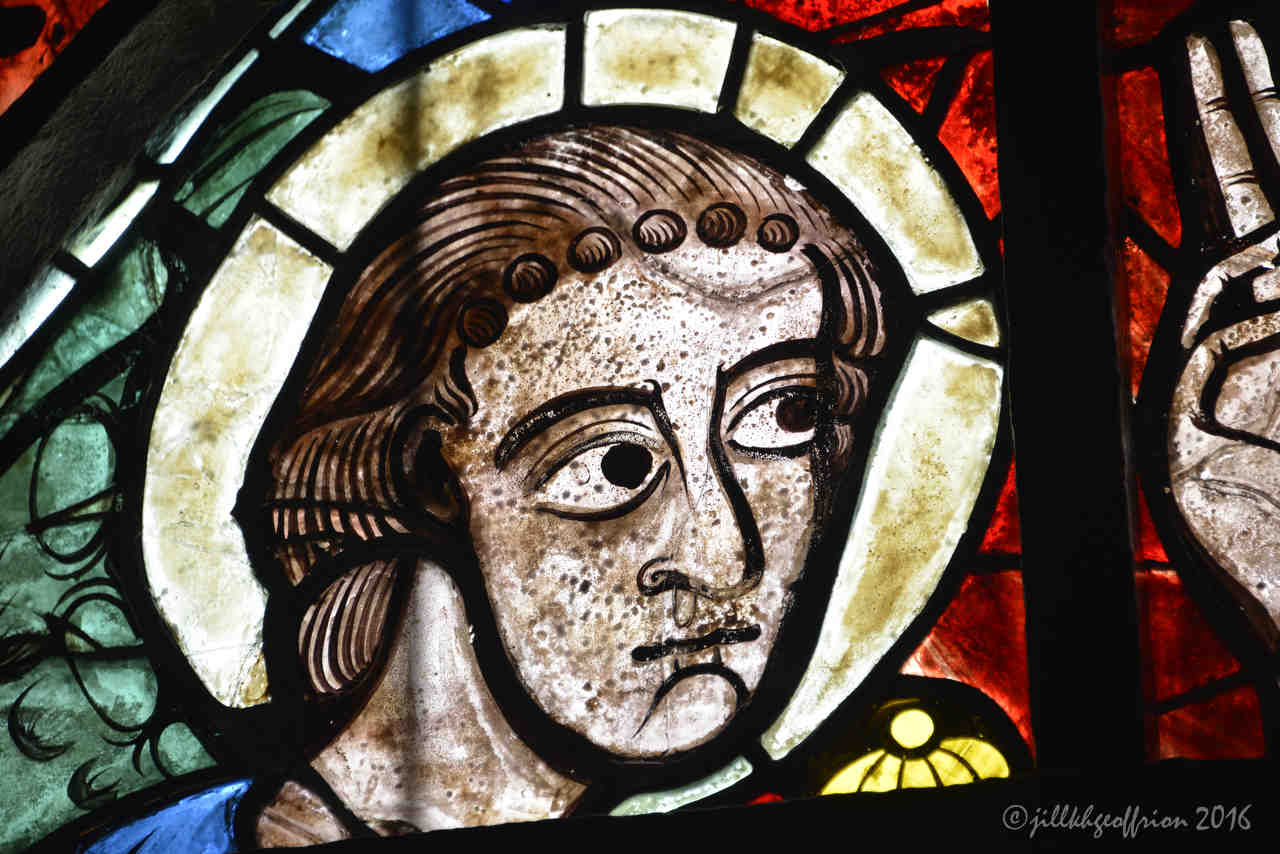
The Servane de Layre-Mathéus Fund for Research on Chartres Cathedral
The American Friends of Chartres has established a special fund honoring the memory of Servane de Layre-Mathéus (1939-2020), co-founder of Chartres–Sanctuaire du Monde, of the Centre International du Vitrail, and and the driving force for the creation of American Friends of Chartres. Servane dedicated much of her life to the preservation of Notre-Dame de Chartres Cathedral, and to the pursuit and transmission of knowledge of medieval art, culture, and spirituality. In recognition of her contributions, she was made chevalier of the Légion d’honneur, officier des Arts et des Lettres, and officier de l’ordre national du Mérite. The fund is intended to support research that furthers her work.
Joanna Fronska
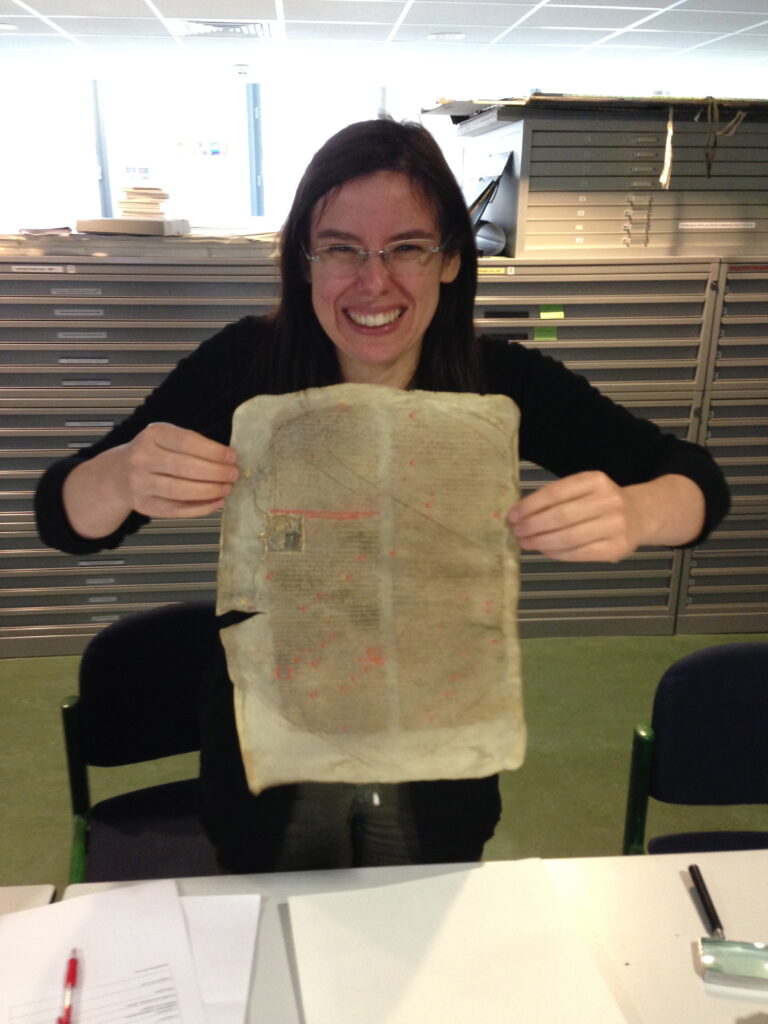
2025 Recipient: Joanna Fronska, PhD, is since 2014, a member of the Section des manuscrits enluminés at the Institut de Recherche et d’histoire des Textes, Centre national de la recherche scientifique. Her research interests include the iconography, production, and use of legal manuscripts and the history of libraries in the medieval and modern periods. Together with Claudia Rabel, she directs the long-term project “Rediscovering the Manuscripts from Chartres. Study and virtual revival of a damaged manuscript collection” and the new edition of the catalogue of medieval manuscripts from the Médiathèque l’Apostrophe de Chartres. Her current work focuses on the history of the cathedral chapter library of Chartres.
Research
The grant supported the creation of a hands-on reconstruction workshop led by Joanna Fronska, the project’s applicant, together with Claudia Rabel. The workshop team consisted of four postgraduate researchers—Katsiah Briard (ENS Lyon), Angela Cipriani (EPHE Paris), Matteo Esu (EPHE Paris), and Iwona Krawczyk (Polish Academy of Sciences, Cracow)—working with the expert assistance of Véronique Trémault (Institut de Recherche et d’Histoire des Textes, CNRS) and Michèle Neveu (Médiathèque l’Apostrophe, Chartres). The workshop focused on the physical reconstruction of burned and fragmented manuscripts destroyed in 1944. Over the course of the project, fragments from 44 volumes were successfully restored to their original sequence, and several inaccuracies found in existing online reconstructions and digitizations were identified and corrected.
Jean Beuvier
2024 Recipient: Jean Beuvier holds a PhD in Art History and is the author of a dissertation on sculpted ornament “in the antique style” in France at the beginning of the sixteenth century (Tours, Université de Tours – Centre d’études supérieures de la Renaissance, 2022). He is currently involved, as part of a postdoctoral fellowship, in a collaborative research project at the University of Lausanne (2025–2027) devoted to the creative processes of sixteenth- and seventeenth-century sculptors. His research focuses in particular on ornamental sculpture, the conditions of its commission and design, its materiality, and the ways it was perceived and received in different contexts. More broadly, his work examines the circulation of forms and artistic knowledge across Europe, as well as interactions between different fields of artistic production.
Research
“Like a Paradise”: Ornament in the Service of Faith in the Choir of Chartres Cathedral (13th–16th Centuries)
This project examined the formal and symbolic relationships between painted decoration (stained glass and illuminated liturgical books) and sculpted decoration (the choir screen and choir stalls) produced for the choir of Chartres Cathedral between the thirteenth and sixteenth centuries. Building on the research conducted by Claudine Lautier (2003) and my own previous work (2022), the study highlights the existence of a coherent iconographic program, conceived both to foster the devotion of the faithful and to assert the institutional identity of the canons throughout the period under consideration. Representations of relics, treasury objects, and miracles were developed in close relation to the liturgy and to devotional practices. They functioned both as aids to prayer for the faithful and as instruments of legitimation for the chapter. The identification of recurring motifs and themes across these different media also reveals interactions between images of different dates, scales, and materials within the space of the cathedral choir. Described as “like a paradise” at the time of the queen’s entry into Chartres in 1534, the cathedral choir thus presented a true combination of the arts in the service of faith, whose coherence this project sought to reconstruct.
Elias Feitosa de Amorin, Jr.

2023: Elias Feitosa de Amorin, Jr. Brazilian PhD student at the Sorbonne, Paris, France. Mr. Feitosa de Amorim Jr holds undergraduate and master’s degrees in art history from the University of Campinas, Brazil.
Research
Mr. Feitosa de Amorim Jr examines the Marian imagery and liturgy of Chartres as the product of theological debates and artistic exchanges over time from the Byzantine era to the 13th century and across the Christian world. His research focuses on the 12th– and 13th-century stained glass at Notre-Dame de Chartres, and draws from the archives held in Chartres, Orléans and Paris.
Shelley Williams

2022 Recipient: Shelley Williams, recipient of the Dietlinde Hamburger grant. American PhD student at Oxford University, England. Ms. Williams holds an undergraduate degree in art history from Brigham Young University, Utah.
Research
Ms Williams’s research brings together medieval English literature and art history. She examined the zodiac images on the western portals and north porch of Notre-Dame de Chartres in order to consider how a medieval traveler would have seen them, and how that experience might have played out in the writing of Geoffrey Chaucer in particular. She proposes a new reading of the arrangement of the sculpture representing zodiac signs and Labors of the Months on the western portal, something that art historians have puzzled over for many years.
restore and preserve the cathedral of Notre-Dame de Chartres
Your contributions are tax deductible in the United States to the extent allowed by law.